VFW has played an integral part in almost every piece of veterans’ legislation signed into law for more than 125 years.
VFW advocates daily at the nation’s capital to improve care and benefits for the military community. The force of the more than 1.3 million VFW and Auxiliary members’ influence helps the organization achieve its legislative goals.
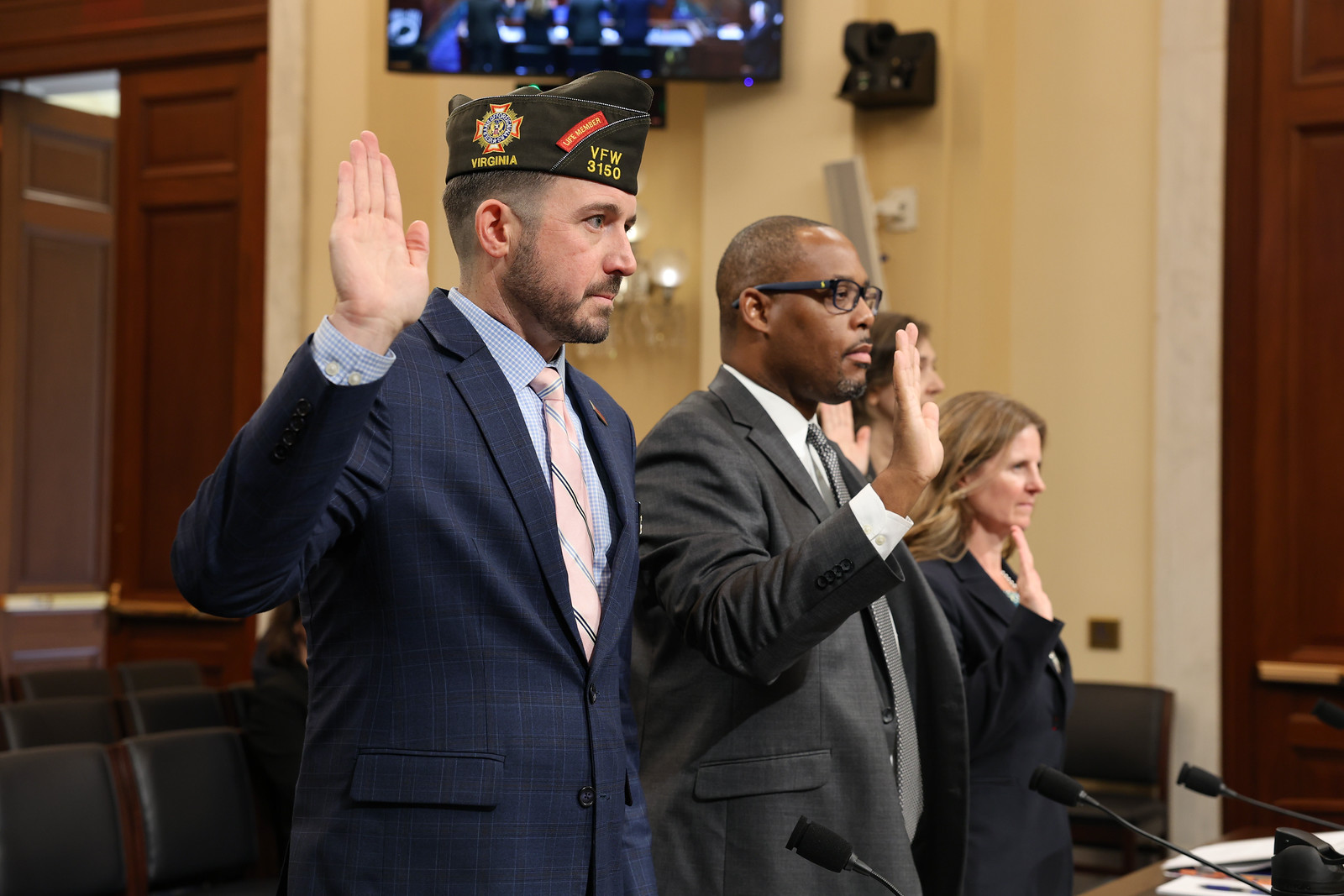
VFW’s National Legislative Service (NLS) monitors all legislation affecting active-duty service members, veterans and their families. The NLS team regularly testifies at congressional committee hearings and works directly alongside Congress and the president’s administration to accomplish VFW’s priority goals — and to fight back against bad proposals that would eliminate or cause harm to veterans’ earned benefits.
Every year since 1949, Congress has provided VFW with the opportunity for the organization’s leaders and activists to speak with lawmakers and staff of their respective states.
The PACT Act and Toxic Exposure
Signed in 2022, the Honoring Our Promise to Address Comprehensive Toxics (PACT) Act serves to expand VA health care and benefits to veterans exposed to harmful toxics, including veterans of the Vietnam, Gulf and Post-9/11 eras. Just as important, the PACT Act includes a framework for VA’s evaluation of toxic exposures that were not included in the legislation. VFW continues to urge Congress to conduct oversight of VA’s presumptive process, because veterans with serious health conditions cannot keep waiting.
Exploring New Mental Health Treatments
VFW acknowledges the growing need for alternative treatments to mental health care. The organization has endorsed a bill that would allow for a study of psychedelic drugs in treating conditions such as PTSD. Introduced in the House on April 3, the Innovative Therapies Centers of Excellence Act of 2025 (H.R. 2623) would be led by a panel of experts in innovative therapies and would designate at least five VA medical facilities as specialized locations to study alternative treatments involving MDMA, psilocybin and DMT, among other substances. The goal is to increase efficiency in treating anxiety, bipolar disorder, chronic pain, depression, Parkinson’s disease and PTSD.
A Win for Caregivers and Elderly Veterans
The Senator Elizabeth Dole 21st Century Veterans Healthcare and Benefits Improvement Act, also known as P.L. 118-210, was a bill VFW advocated heavily for. It was officially signed into law by former President Joe Biden on Jan. 2, 2025, and will:
- Expand benefits related to caregiving for elderly and infirmed veterans.
- Increase accessibility for in-home care resources.
- Extend timelines and eligibility for certain GI Bill Programs.
- Provide further funding for mental health services and shelters for homeless veterans.
Advocating for the 2026 VA Budget
Working alongside Disabled American Veterans (DAV), Paralyzed Veterans of America, and The Independent Budget Veterans Service Organizations (IBVSOs), VFW provided its recommendations for the 2026 Veteran Health Administration (VHA) budget. The Independent Budget, designed to help guide Congress on where to allocate spending for veteran services, infrastructure and care, includes notable items and price points such as:
- Medical care, $132.7 billion
- Medical community care, $33.7 billion
- Construction projects, $9.6 billion
- Information technology, $8.2 billion
- Veterans Benefits Administration, $6.5 billion
- Prosthetic and medical research, $1.2 billion
VFW will continue to advocate for funding transformative and extensive care for veterans through The Independent Budget, and for the VA to remain the primary coordinator of veteran care.
Giving Student Veterans a Voice on Capitol Hill
For the past decade, VFW has provided a platform for student veterans to assist in legislative efforts. Since 2014, VFW and the Student Veterans of America (SVA) have given student veterans the opportunity to have their voices heard on Capitol Hill. Throughout the semester-long fellowship, fellows work closely with lawmakers and administrators who implement policies relating to veterans.
According to 2024-2025 VFW/SVA Fellow and Marine Corps veteran Terry Traylor, the fellows focused primarily on the G.I. Bill and the National Guard and Reserve G.I. Bill Parity this past semester. The latter would expand the parameters for G.I. Bill eligibility — under the bill, “every day in uniform” (weekend drills, annual training and federal active duty) would count towards G.I. Bill eligibility.
The fellowship allowed Jennifer Ross, an Air Force veteran, to become more involved with VFW, for which she had little experience prior. Now a member of VFW Post 1503 in Montclair, Va., she praised how seamlessly the two organizations worked together throughout the fellowship.
“I was most grateful for the kind-of dual nature of it,” Ross said. “It wasn’t just the SVA or the VFW. I liked how closely they worked to create a phenomenal program. Each piece offered such a unique viewpoint on how they individually handled policy.”
Staying Informed Through Action Corps
To include all VFW members in legislative processes, VFW sends out the Action Corps — a weekly grassroots newsletter that provides readers with up-to-date information on advocacy efforts in Washington, a nationwide database of contact information for elected officials, and “action alerts” detailing how to help veterans get their voices heard when it’s needed most. Currently, more than 300,000 VFW members are subscribed to the newsletter. Members can easily sign up for Action Corps through the VFW website.
Photo credits: Bob Knudsen; Sarah Weede